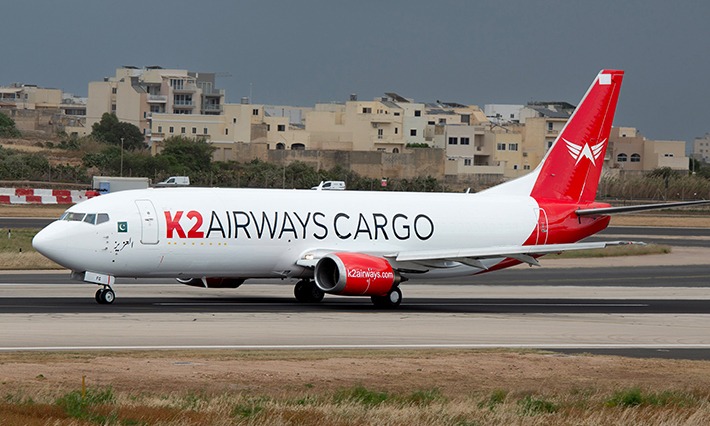
The K2 Airways crash is, on the surface, a deep‑sea accident. Underneath, it is an x‑ray of how weak oversight and a single‑aircraft business model can line up with a bad night and leave Pakistan’s aviation safety exposed.
On July 7, K2 Airways Flight 1732, a 27‑year‑old Boeing 737‑400 freighter converted from passenger service left Sharjah for Karachi with five crew on board, two pilots, two engineers, one loadmaster. Around 21:18 Pakistan time cruising near 36,000 feet over the Arabian Sea about 150–155 nautical miles west of Karachi the crew radioed a navigational system failure and asked Karachi ACC for radar vectors. Controllers kept them on present heading and tried to guide them in. Within three minutes the flight tracking picture turned chaotic the 737 dropped thousands of feet briefly climbed again and then entered a near‑vertical dive.
Flightradar24’s ADS‑B data shows the final moments starkly. After the initial upset the aircraft’s last transponder point was at around 1,100 feet above sea level with a recorded descent rate of about 22,400 feet per minute roughly five times faster than a controlled emergency descent. Radar contact vanished at 21:21 three minutes after the first distress report and the aircraft never reappeared. Twelve hours later, Pakistan Navy and Maritime Security Agency ships and aircraft located wreckage 53 nautical miles south of Ormara in water 2,500–3,500 metres deep. That depth makes recovering the cockpit voice recorder and flight data recorder among the hardest tasks Pakistan’s investigators have ever faced. That needs deep‑sea equipment more commonly used in oceanic air disasters not coastal searches.
The bare facts are bad enough. A cargo flight, routine route, no weather drama, an older but widely used aircraft type a reported instrument failure and then a catastrophic loss of control. But the deeper story lies in who was operating this aircraft and how.
K2 Airways as of 2026 was a single‑aircraft cargo carrier. Its only jet was AP‑BOI the 737‑400 that crashed. It was acquired in 2024 and run on Sharjah–Karachi freight sectors. As per reports from agencies, the aircraft had spent roughly ten days in Sharjah undergoing maintenance before the accident including repairs to systems that Pakistan’s Civil Aviation Authority (PCAA) had previously flagged. In other words this was not a high‑redundancy operation with a fleet of spares and mature processes. It was a one‑plane airline whose entire business depended on keeping a 27‑year‑old freighter flying with minimal downtime.
Single‑aircraft operators are not automatically unsafe but they are structurally fragile. Every delay hurts revenue. Every heavy maintenance check is an existential event. In that environment, the line between run it until we can afford a replacement part and take it out of service until we have full confidence is blurred. The crash has therefore triggered hard questions about PCAA’s oversight of K2. What surveillance did inspectors apply to a carrier whose only aircraft was nearing three decades in age and had recently been converted to cargo use. How rigorously were defects tracked and how conservative were decisions on dispatch after maintenance in Sharjah. Did Pakistan’s regulations on ageing aircraft, freighter conversions and operator minimum scale translate into real checks and balances or were they treated as paperwork boxes to tick.
The descent profile itself hints at more than a simple instrument glitch. A navigational failure can be handled. Crews are trained to revert to raw data use backup systems and accept vectors from radar. What Flightradar and ATC reconstructions show instead is an upset where the aircraft appears to roll and pitch into unstable attitudes with the last words reportedly describing the jet as 'rolling and floating' before the instruments went beyond normal. That kind of motion points towards either a major systems failure cascading beyond navigation for example, flight control or attitude reference problems, or a severe loss of situational awareness in the cockpit. Without the recorders, investigators will have to rely on recovered wreckage, maintenance logs and any surviving data to parse which path the accident took.
Pakistan has spent years trying to climb back from the damage of the 2020 PIA Karachi crash and international bans on its pilot licences. The K2 accident comes after the country has promised a tightened safety regime. Seeing a lone ageing freighter plunge into deep water after reporting a basic systems fault inevitably raises doubts among international partners about whether those promises have translated into day‑to‑day oversight.
The agony is more immediate for crew's families as no bodies recovered yet, no black boxes recovered and an investigation that begins at an ocean depth where nearly every step will be slow expensive and uncertain. For Pakistan’s aviation system the choice is harder. It can treat this as an isolated tragedy citing a bad aircraft, bad luck, one carrier. Or it can treat it as a stress test that exposed weak points in how small cargo operators are certified, monitored and supported in a world where safety reputation is doubtful. A single 737 crashing straight down at 22,000 feet per minute can undo years of slow rebuilding.