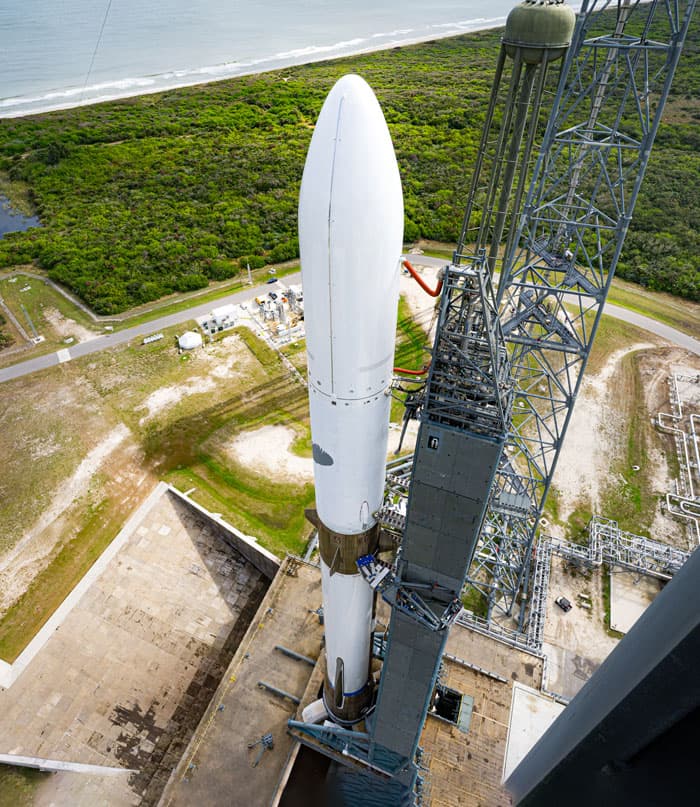
Blue Origin wants to raise the permitted launch rate for its New Glenn rocket at Cape Canaveral Space Force Station from 12 to as many as 50 missions a year. The Federal Aviation Administration published a draft environmental assessment on September 29th and opened the proposal to public comment. It is not permission for 50 launches. Blue Origin must still secure a modification to its existing vehicle-operator licence and meet the FAA’s separate safety and financial-responsibility requirements.
The proposed increase would make New Glenn a roughly weekly event at Space Launch Complex 36, rather than an occasional operation. The assessment covers more than liftoffs, up to 100 static-fire engine tests annually, booster landings on offshore platforms, payload-fairing recovery and temporary airspace closures.
That turns launch cadence into an air-traffic-management question.
Before a rocket climbs, the FAA must protect the airspace through which it will pass and the areas where debris, stages or recovering hardware might fall. Notices to Air Missions warn pilots, temporary flight restrictions and controlled airspace measures keep aircraft clear. Airlines may reroute, adjust fuel loads, delay departures or accept longer tracks. General-aviation pilots, who often have fewer dispatch resources and tighter fuel margins, face the same practical instruction: stay out.
At 12 launches a year, disruption can be an exceptional event. At 50, it begins to resemble scheduled infrastructure. The Cape’s launch calendar would need increasingly close coordination with Orlando International, Melbourne Orlando International, Daytona Beach International, Sanford Orlando and the dense network of general-aviation airports along Florida’s east coast.
The effect on any particular airline flight may be small. A reroute of a few minutes is not a crisis. But air-traffic management works through margins. A delay caused by weather, a crowded arrival bank or a runway closure can spread through an airline’s network. Add a launch window, and a narrow margin becomes another operational constraint.
The question is not whether commercial aviation and spaceflight can coexist. They already do. It is whether they can coexist at a tempo once reserved for airport traffic.
Cape Canaveral also faces a maritime version of the same problem. Rocket launches and offshore booster landings require warning zones at sea. Mariners may be asked to avoid designated areas; the Coast Guard is a cooperating agency in the review. The proposed operations include up to 50 first-stage booster landings on ocean platforms and fairing-recovery activity, adding to the choreography of ships, launch support vessels and other traffic offshore.
The most important operational detail will be timing. A launch window that moves because of weather or a technical hold can be more disruptive than a launch that proceeds precisely on schedule. Airlines, air-traffic controllers, airports and space-launch operators need not just advance notice but shared, reliable information on the likelihood that a window will open, slip or be scrubbed.
Florida’s airspace is already becoming a crowded departure lounge for space. SpaceX holds approval for up to 120 Falcon 9 launches a year from Cape Canaveral’s Space Launch Complex 40, including associated airspace closures and booster-landings operations. It is also pursuing a much larger Starship cadence. Blue Origin’s request must be judged not in isolation but against this accumulating demand for the same sky and sea.
The draft assessment concludes that some effects would be unavoidable but does not identify potentially significant impacts. It is examining noise, wildlife, cultural resources, health and safety, aviation emissions and air quality. The public-comment period runs through October 30th, with a virtual meeting scheduled for October 22nd.
Environmental review will decide whether the proposal may proceed under the FAA’s process. It cannot, by itself, settle the more practical question of capacity. A rocket launch is still an extraordinary event. Fifty of them a year would make extraordinary events routine.
The future of the Space Coast may therefore depend as much on coordination as on propulsion. Rockets need a clear corridor to orbit. Airlines need dependable corridors through Florida. The FAA’s challenge is to ensure that one does not ground the other.