In April 2026, Ukrainian President Volodymyr Zelensky announced what many analysts call a watershed moment in modern warfare: for the first time in the history of the Russia-Ukraine conflict, Ukrainian forces captured a Russian position using *exclusively* unmanned systems—ground robots and aerial drones—with no infantry involvement and zero Ukrainian casualties. Russian troops surrendered to the machines.
Zelensky described the operation as proof that “the future is here, on the battlefield, and Ukraine is creating it.” He added that Ukrainian drones and ground robots had carried out more than 22,000 frontline missions in just the previous three months.
A Ukrainian-British defence startup, UFORCE, has been at the forefront of this shift. The company, which has conducted over 150,000 successful combat missions with air, land, and sea drones since Russia’s full-scale invasion in 2022, has achieved unicorn status (valuation over $1 billion). Its UK director of strategic partnerships, Rhiannon Padley, told British National chanenl that battlefields where robots outnumber human soldiers are no longer science fiction but an emerging reality.
What’s Actually Happening on the Battlefield
The Russia-Ukraine war has become the world’s largest testing ground for unmanned systems. Both sides now deploy thousands of air, ground, and maritime drones daily.
On air domain, Ukrainian first-person-view (FPV) drones have become the primary anti-armor weapon, hunting tanks, artillery, and infantry with precision. Russian forces reply with their own FPV swarms and Lancet loitering munitions. Drone-on-drone dogfights—FPVs intercepting reconnaissance drones or other FPVs—are now routine.
On ground, unmanned ground vehicles (UGVs) handle logistics, mine-clearing, casualty evacuation, and direct assaults. Ukrainian UGVs such as the Droid TW series and systems from Devdroid have delivered hundreds of kilograms of explosives into Russian positions, acted as mobile machine-gun platforms, and even held defensive lines for weeks. Russia has responded with its own growing fleet of UGVs, including the Kuryer and Impulse-M models, used to deliver explosives and supplies into Ukrainian lines.
On water, Ukrainian Magura V5 and Sea Baby uncrewed surface vessels (USVs) have repeatedly struck Russian warships in the Black Sea, forcing Moscow’s Black Sea Fleet to relocate and altering naval strategy. Russia is now fielding its own USVs in response.
The Inflection Point: Robots Fighting Robots at Scale
Experts say the war has crossed a threshold. UFORCE’s Padley echoed this, predicting that 'the phenomenon of robots fighting robots to become more common, with unmanned systems even outnumbering human soldiers.'
Ukraine’s Defence Ministry plans to field 25,000–50,000 ground robots in 2026 alone, aiming for 100% robotic frontline logistics. Russia has scaled serial production of dozens of UGV models. The result tobe multi-domain swarms combining aerial reconnaissance, FPV strikes, ground assault robots, and sea drones.
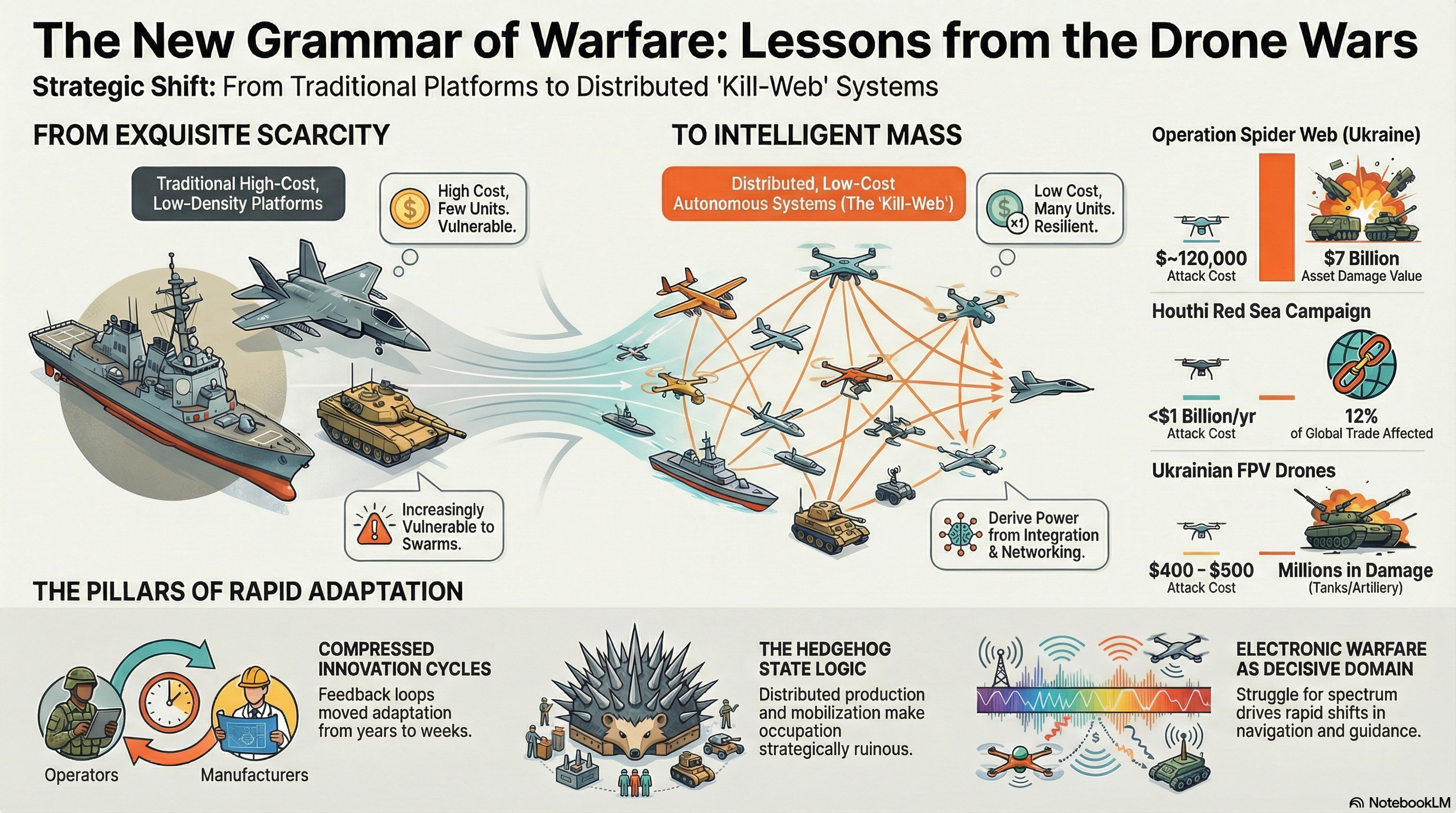
This shift builds on two decades of unmanned evolution. Early U.S. Predator and Reaper drones were billion-dollar strategic assets used for precision strikes in counter-insurgency wars. Today, commercial-grade FPV quadcopters—costing $500–$1,200 each—routinely destroy multimillion-dollar tanks and artillery. Russian analysts note that a single T-90M tank (≈ $3.84 million) is cost-equivalent to roughly 3,200 heavy FPV drones; a BMP-3 infantry fighting vehicle equals about 870 drones.
The economics are brutally asymmetric. A cheap drone swarm can overwhelm expensive traditional platforms, forcing militaries worldwide to rethink procurement. Instead of a few exquisite systems, the future favors “intelligent mass”—thousands of cheap, networked, attritable unmanned vehicles.
Doctrine, Procurement, and Civilian Protection
The implications ripple far beyond Ukraine. Doctrine is shifting toward unmanned combined-arms operations--drones create expanding 'kill zones' where movement without electronic warfare protection is suicidal. Procurement must become agile—rapid iteration, digital supply chains, and commercial partnerships rather than decade-long defence contracts.
For civilian protection, the picture is double-edged. Precision unmanned strikes can theoretically reduce collateral damage compared to mass artillery. Yet the proliferation of cheap, dual-use technology raises risks of autonomous swarms, AI-driven targeting errors, and easier access to lethal systems for non-state actors. There are serious ethical dangers of delegating life-and-death decisions to machines, even with a 'human in the loop'.
The New Grammar of War
What began as an experiment in asymmetric resistance has become a global inflection point. In Ukraine’s skies, fields, and Black Sea waters, swarms of cheap robots are not just supporting soldiers—they are replacing them. As UFORCE and Zelensky have shown, the age of the robot battlefield is no longer coming. It is here.