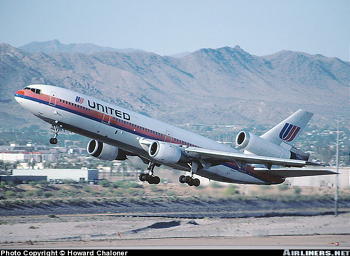
One hundred and eleven people died when United Airlines Flight 232 struck the ground at Sioux Gateway Airport on 19 July 1989. One hundred and eighty-five survived the impact and the fire that followed. The McDonnell Douglas DC-10 had been climbing through 37,000 feet on the way from Denver to Chicago when the fan disk in the tail-mounted engine broke apart. Fragments cut all three hydraulic systems that powered the flight controls. The crew could still move the thrust levers of the two wing engines. They could not move the ailerons, elevators or rudder in any normal way.
Captain Alfred Haynes, First Officer William Records and Flight Engineer Dudley Dvorak worked the control columns and systems while the aircraft began a series of slow climbs and descents. Off-duty DC-10 instructor Dennis Fitch, travelling as a passenger, came forward after a flight attendant passed his offer of help. He knelt between the pilots and took the two remaining thrust levers, one in each hand. Adding power on one side and reducing it on the other produced a slow turn. Adding power on both engines raised the nose. Reducing power on both allowed a descent. The aircraft continued to oscillate in altitude, and each correction arrived only after a delay of several seconds. Normal control never returned.
In the cabin the flight attendants secured the passengers and prepared them for a hard landing. Controllers at Minneapolis Center and then at Sioux City cleared the way, gave the crew vectors toward the airport and arranged for emergency vehicles to meet the aircraft. On the ground, airport fire and rescue crews, joined by Iowa National Guard personnel already on duty, positioned equipment along the runway. The shared work continued until the final moments. The aircraft touched down hard, the right wing struck, and the fuselage broke apart and burned. Responders reached the survivors within minutes.
The National Transportation Safety Board later determined that the initiating failure was an undetected fatigue crack in the stage-1 fan disk of the No. 2 engine. The crack had grown from a metallurgical defect that originated during manufacture. Inspection and quality-control procedures at United’s engine overhaul facility did not account for human-factors limitations and therefore failed to find the crack while it was still small. Debris from the disk then exceeded the protection designed into the hydraulic systems. The Board treated the inspection shortfall as the cause of the loss of control and treated the subsequent crew and responder actions as a separate record of what could still be done once normal flight controls were gone.
The crew and the people on the ground worked with the two engines that remained and with the time the aircraft still had. They reached an airport. They landed. One hundred and eighty-five people lived.