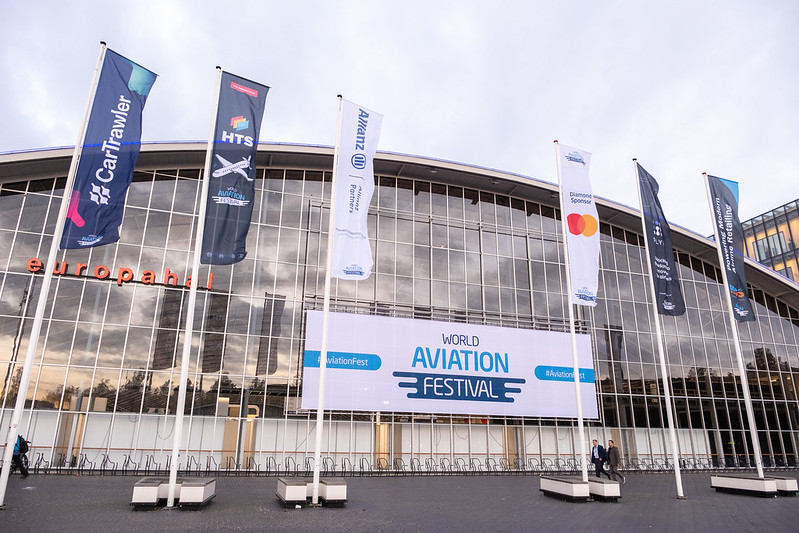
The World Aviation Festival opens in Lisbon on 13 October with an agenda full of AI, retailing, biometrics, airport technology, payments, operations and sustainability. But the industry’s real divide is less about who has the most impressive demonstration and more about who can fund technology that works during disruption, and who is still trying to keep basic airport and airline systems running.
The event will bring together more than 4500 attendees and 600 speakers at FIL Lisbon from 13 to 15 October. Its agenda includes a new airline, airport collaboration track, a useful acknowledgement that passenger disruption is rarely solved by one organisation’s software alone.
The technologies with the clearest operational value in 2026 are not necessarily the most visible passenger-facing products. IATA’s baggage strategy illustrates the difference between a gimmick and a system. Its Resolution 753 requires participating airlines to track bags at four core points, and the industry strategy aims for trusted data exchange and greater automation across airlines, airports and ground handlers.
That is not glamorous technology. It is infrastructure for preventing a passenger from arriving without their bag and for telling them, accurately, where it is when something goes wrong.
Airlines buy some technology because it might increase revenue. They buy other technology because disruptions have made operating without it too expensive.
'Want' technology often includes sophisticated retailing engines, loyalty personalisation, dynamic ancillaries, marketing automation and AI-assisted travel search. These can raise revenue, but a weak airline can survive without the most advanced version.
'Must-have' technology includes cyber security, flight-operations systems, crew and aircraft recovery tools, baggage reconciliation, payments resilience, airport-resource management and reliable passenger notification. These determine whether the operation functions during weather, ATC restrictions, aircraft faults, baggage failures or airport closures.
The Lisbon agenda reflects this tension, it includes AI and commercial tracks, but also ground operations, digital operations, cyber security and airport–airline resilience.
A wealthy hub airport can install biometric gates, rebuild its baggage system, hire cyber-security teams, buy modern airport-operation databases and absorb the cost of integration consultants. A smaller airport may have unreliable connectivity, fragmented ground handling, limited IT staff, legacy check-in systems and no spare capital after paying for firefighting, runway maintenance and security.
That does not mean smaller airports should avoid digitalisation. It means they should avoid buying technology in the wrong order.
The problem is not that a secondary airport lacks facial-recognition gates. The problem is when it buys impressive front-end automation while lacking the people, redundancy and shared data needed to handle a delayed aircraft, a missed bag or an evacuation.
India’s airport system should treat technology as an operational-capacity tool, not merely a passenger-experience accessory. The most useful near-term investments are likely to be those that help airports manage rapid growth, varied airline operating models and recurring weather or congestion disruptions.
The World Aviation Festival programme itself includes Indian representation, with Bengaluru International Airport’s chief operating officer scheduled to discuss airline-airport alignment. That is a more valuable conversation than a generic 'smart airport' presentation with airlines, handlers and airports cannot individually optimise an operation that depends on the others.
Lisbon should be judged by a simple question as to which products will still work at 2 a.m. during a thunderstorm, baggage-system failure, ATC delay or mass cancellation?
The industry’s technology divide will not be closed by giving every airport the same shiny tools. It will narrow when the most useful systems-accurate data, functioning baggage tracking, disruption recovery, cyber protection and accessible passenger support-become affordable, interoperable and resilient enough to work outside the world’s richest hubs.