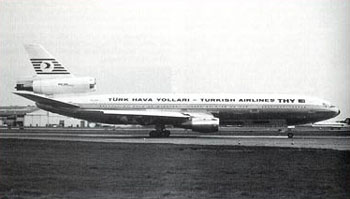
On 3 March 1974 Turkish Airlines Flight 981 left Paris-Orly for London. The McDonnell Douglas DC-10-10 climbed through 11500 feet. The aft left cargo door separated. Explosive decompression collapsed the cabin floor. Control cables to the tail surfaces were severed or jammed. The aircraft entered a steep dive and struck the forest of Ermenonville. All 346 people aboard were killed.
The French investigation concluded that the accident resulted from the in-flight ejection of the aft cargo door. The sudden depressurisation disrupted the floor structure, rendering the number 2 engine inoperative and impairing the flight controls so that the crew could not regain control. The underlying factor was the incorrect engagement of the door latching mechanism before take-off. The design of the mechanism allowed the door to appear locked when the latches were not fully closed and the lock pins were not in place. The same characteristics had been identified after the American Airlines Flight 96 event near Windsor, Ontario, on 12 June 1972.
After Flight 96 the NTSB issued two safety recommendations to the FAA. One called for a modification that would make it impossible to stow the door handle unless the latches and lock pins were fully engaged. The second called for relief vents between the cabin and the cargo hold so that loss of a door would not collapse the floor and disrupt the control cables. No airworthiness directive covering the cargo-door latching system was in effect at the time of the Windsor event. McDonnell Douglas had issued service bulletins, including one that addressed the electrical wiring to the latch actuators. These bulletins were not mandatory. The FAA response described inspections and service bulletins. A preliminary assessment indicated that complete venting of the floor might not be feasible. No binding airworthiness directive requiring the NTSB’s two recommended changes was issued before Flight 981.
The aircraft that crashed near Paris had been delivered after the service bulletins were released. Records indicated that the modifications had been accomplished. Examination of the recovered door showed that the support plate intended to prevent forced closing of the handle when the latches were incomplete had not been installed. The lock pins and the warning switch were incorrectly adjusted. The person who closed the door in Paris reported no particular difficulty and no abnormality. The French report stated that all the risks had already become evident nineteen months earlier at Windsor, yet no effective corrective action had followed.
Four days after the Ermenonville crash the FAA issued a telegraphic airworthiness directive that mandated the cargo-door modifications it had not required in 1972. A complete redesign of the latching system followed. A later directive required cabin floors on wide-body aircraft to be able to withstand a sudden large opening in the fuselage. The sequence shows how a documented failure mode was addressed through voluntary service bulletins rather than mandatory action, what remained vulnerable on an aircraft that left the factory without the critical support plate, and the point at which corrective action became binding.