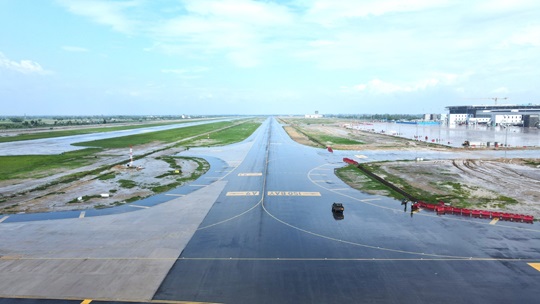
On the morning of 15 June 2026, IndiGo flight 6E-2278 touched down at Noida International Airport (DXN) in Jewar after a short hop from Lucknow. It was the first scheduled commercial arrival at India’s newest major greenfield airport. Cameras captured the moment. Speeches had already been made in March when Prime Minister Narendra Modi inaugurated the first phase. But the real opening the one that mattered operationally, happened quietly in the days that followed, and it was not decided by concrete, glass, or the 3,900-metre runway.
It was decided by people most passengers never see, flight dispatchers with flight plans, stand planners moving aircraft icons across digital maps like chess pieces, fuelling teams racing against turnaround clocks, and tow crews guiding multi-tonne machines across an apron they had only ever practised on during trials.
Noida International Airport received its aerodrome licence from the DGCA on 6 March 2026 and was inaugurated on 28 March. Commercial operations, however, did not begin until 15 June, a deliberate gap filled with Operational Readiness, Activation and Transition (ORAT) trials, including full-scale aircraft turnaround simulations with IndiGo. That gap, and the modest initial schedule, gave the human system time to learn the airport before the airport had to learn them.
Phase 1 of Noida is designed for 12 million passengers a year. In its first week of operations, the airport handled a far smaller number, roughly 140 weekly flights, dominated by IndiGo (around 126) with Akasa Air adding services from 16 June. The schedule was deliberately daytime-only at the outset. This was not under-ambition. It was operational realism.
A new airport’s first week is when every interface is tested for the first time under live conditions. New radio frequencies with ATC, new stand markings, new fuel hydrant or bowser procedures, new security flows, and new coordination protocols between the airport operator, ground handler, airlines, and fuel companies. Starting small reduces the chance that one delayed fuelling or one misallocated stand creates a cascade that turns 'new airport' into 'new airport with problems' in the first headlines.
Those who actually run the airport
Flight dispatchers are the brains of every departure. They file flight plans, calculate fuel loads accounting for weather and alternate airports, check NOTAMs, and coordinate with crew and ATC. At a brand-new airport they must also absorb unfamiliar local procedures and any last-minute changes to the airport’s own documentation. One small error in a fuel figure or a missed restriction can ground an aircraft or force an expensive diversion.
Stand planners (sometimes called gate or apron planners) decide where every aircraft parks. In a new facility this is live spatial puzzle-solving. They must minimise taxi times, avoid conflicts between arriving and departing aircraft, protect pushback paths, and work within the physical constraints of a brand-new apron layout that exists only on paper until the first day of operations. Their decisions directly affect on-time performance and the workload of every other ground team.
Fuellers are on the critical path of almost every turnaround. Whether using a new underground hydrant system or mobile bowsers, they must deliver precise quantities safely and quickly. At a new airport the procedures, equipment, and even the physical layout of the fuel farm are untested in live operations. A single slow or interrupted fuelling can push an entire bank of departures behind schedule.
Tow and pushback operators move aircraft when they cannot or should not taxi under their own power. This is precision work involving heavy equipment, wing walkers, and constant radio communication. On an unfamiliar apron, with new markings and potentially different surface conditions, the risk of minor incidents or delays is highest in the first days and weeks. Every pushback that goes smoothly is the result of training, muscle memory, and real-time coordination that only exists because teams have drilled it.
Noida did not start from zero on the human side. Bird Group (through Bird Flight Services) had won the ground-handling concession years earlier and already operates at Delhi and other Indian airports. Bringing in an experienced handler with established procedures and trained staff reduces one of the biggest variables in a new airport launch. The airport also ran multiple layers of ORAT trials, including integrated aircraft turnaround exercises. These are not publicity exercises. They are the aviation equivalent of dress rehearsals where every handoff, dispatcher to stand planner to fuelling team to tow crew to cabin crew, is tested and refined.
The limited initial flight schedule further helped. With fewer movements per hour, teams could absorb the inevitable small frictions of a new environment. That does not mean week one was effortless. It means the friction stayed mostly invisible to passengers because the people on the ground absorbed it. New radio phraseology with ATC, learning the exact timing of every pushback on a new apron, adjusting stand allocations when an aircraft arrived slightly off schedule, these are the micro-adjustments that either prevent or create delays. They happen in real time, often under time pressure, and they depend entirely on human judgement, communication, and experience.
India is in the middle of one of the largest airport expansion programmes in the world. New terminals, new runways, and entirely new greenfield airports are being added at a pace that outstrips most other major aviation markets. The physical infrastructure receives the ribbon-cuttings and the dramatic photography. The human operating system, the training, the coordination protocols, the muscle memory of teams working together on a specific apron, receives far less attention until something goes wrong.