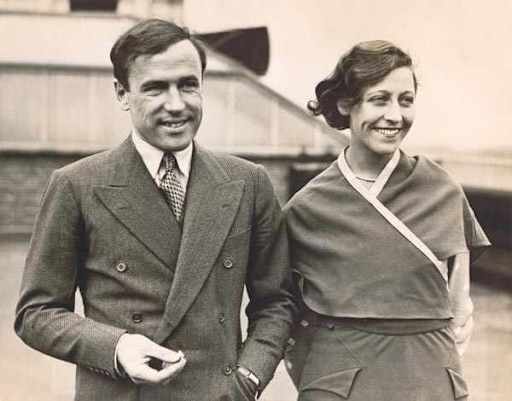
Amy Johnson wore black to her wedding. Jim Mollison wore a grey lounge suit. Outside St George’s, Hanover Square, admirers gathered to see two of Britain’s most celebrated pilots begin married life. A contemporary report recorded the occasion and a revealing declaration. Johnson said neither intended to interfere with the other’s flying plans.
They married on July 29, 1932. The newspapers knew them as the 'Flying Sweethearts', a description that neatly joined romance with the glamour of record-breaking aviation. Their wedding-day statement suggested a more complicated partnership. These were two people accustomed to choosing their own destinations.
Johnson had already made history. In 1930, she became the first woman to fly solo from Britain to Australia, nursing a second-hand de Havilland Gipsy Moth across a demanding route. She was a qualified ground engineer as well as a pilot, capable of maintaining the engine on which her journey depended. Mollison brought his own achievements, including the England-Cape Town air record. Neither entered the marriage as a supporting character.
The RAF Museum records that they met aboard an airliner between Brisbane and Sydney, where Mollison was co-pilot. Historic Croydon Airport recounts that he proposed eight hours after they met. The speed of the courtship suited the public image of aviators who crossed distances others could scarcely imagine travelling. The proposal’s private details, however, should remain beyond the storyteller’s invention.
Their independent ambitions were visible almost immediately. In August 1932, as Mollison departed Ireland on his Atlantic venture, a newspaper attributed a simple declaration to Johnson, “I have perfect faith in Jim.” That same month, contemporary reporting described her preparations for an Atlantic attempt of her own. Confidence in her husband did not require surrendering her own plans.
The following year, they crossed the Atlantic together. Their first departure attempt from Croydon ended when the heavily laden aircraft’s undercarriage collapsed. A subsequent departure from Pendine Sands carried them across the ocean, but fuel shortage prevented them reaching New York. They made a forced landing at Bridgeport, Connecticut, and both suffered minor injuries.
An unfinished flight became a public triumph. New York welcomed them with a ticker-tape parade, and they met President Franklin Roosevelt and Eleanor Roosevelt. The contrast captures something of their celebrity, operational disappointment and popular acclaim could arrive together.
They competed together in the 1934 England-Australia air race. Yet Johnson’s life continued beyond the shared cockpit. She became president of the Women’s Engineering Society in 1935 and set another Britain-Cape Town return-flight record in 1936. Her professional identity remained larger than the romantic headline.
Their marriage did not survive. The RAF Museum records their separation in 1936 and divorce in 1938, linking the breakdown to Mollison’s drinking and womanising.
The affection need not be dismissed because the partnership ended. Nor must its ending eclipse what each achieved. Their wedding-day intention offers the fairest closing perspective, they hoped to share a life without abandoning their flying. The story is richer when both ambitions remain in view.