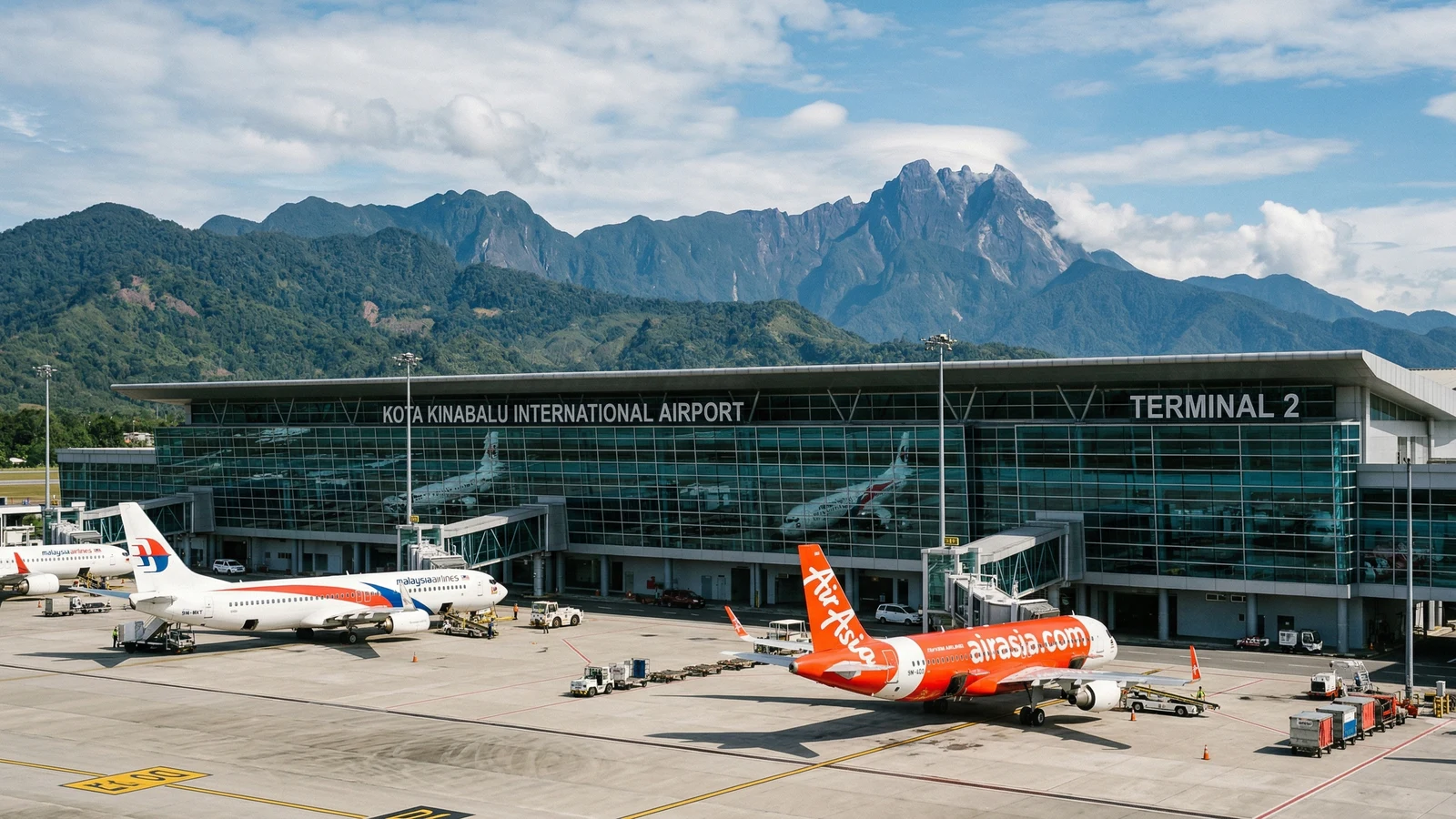
Malaysia Airports has advanced plans to raise Kota Kinabalu International Airport’s annual capacity toward 12 million passengers, up from roughly 9–10 million depending on the baseline used. The works centre on Terminal 1 upgrades and related airside improvements, with completion targeted in the late 2020s. The arithmetic is straightforward. Traffic has recovered and is projected to keep climbing, so the gateway needs more room. The harder question is what that extra room does to the place the passengers come to see.
Kota Kinabalu is not a pure transit hub. It is the principal air entry for Sabah’s islands, dive sites, rainforest and wildlife tourism. Additional seats and wider connections can spread visitor demand more evenly through the year and support higher-value stays. They can also compress peak-season pressure onto limited hotel stock, road capacity, waste and water systems, and fragile marine and forest environments. An airport expansion measured only in million passengers per year risks treating the destination as an unlimited sink. A better measure asks whether hotel supply, conservation management, last-mile transport and local economic benefit are planned on the same timeline as the terminal gates.
Capacity planning elsewhere in Asia has already shown both outcomes. Some destinations have used airport growth to professionalise tourism and fund infrastructure. Others have watched arrival numbers outrun the ability of reefs, trails and towns to absorb them. Sabah’s advantage is that the decision is still being made in public. Linking the airport programme to clear targets for room inventory, marine protected areas, waste handling and community revenue would turn a throughput project into a destination strategy. Leaving those questions to later turns the extra three million passengers into a test the landscape may not pass.
Airports create options. They do not automatically create sustainable visitation. Kota Kinabalu’s expansion will succeed if the extra capacity arrives together with the systems that keep Borneo’s appeal intact, not if the only number that rises is the one on the terminal’s design plate.