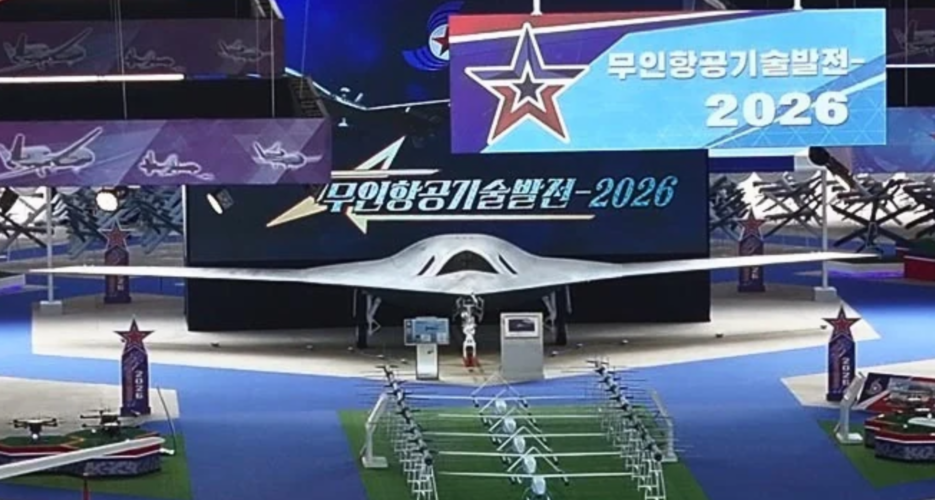
North Korea has displayed a previously unseen flying-wing aircraft at an exhibition of unmanned systems, presenting a design ambition whose performance remains unverified. Images released by state media show a broad, tailless airframe with a blended centre section and an intake above the fuselage. Its appearance invites comparisons with foreign demonstrators. What it can fly, carry, sense or decide remains a separate question.
The aircraft appeared at the Unmanned Aeronautical Technology Development-2026 exhibition attended by Kim Jong Un on 29 October. State media published photographs the following day. Kim called for greater use of drones and artificial intelligence as part of efforts to modernise the country’s armed forces.
The visible configuration is the strongest starting point. Specialist identifies it a flying-wing layout, no vertical tail, an upper air intake and tricycle landing gear. Militarnyi compared its outline with Dassault’s nEUROn and Northrop Grumman’s X-47B. Other analysts have drawn comparisons with different foreign aircraft. The range of suggested parallels itself demonstrates the limits of identifying a programme through silhouette alone.
A flying-wing configuration can be attractive to designers seeking reduced radar visibility. Removing a vertical tail and carefully shaping the aircraft can help manage radar reflections. But an outline is only one part of low-observable engineering. The installation of the engine, treatment of openings, materials and manufacturing details all matter. The published photographs do not establish those characteristics for the North Korean exhibit.
'Stealth combat drone' therefore, goes beyond what the available evidence supports. The defensible description is a displayed flying-wing UAV design, with its development status still unresolved. The War Zone characterises the exhibit as a mockup, while other reporting leaves open whether it is a working aircraft or a display article. North Korea has released no specifications or confirmation that this particular design has flown.
Even a confirmed first flight would answer only the initial question of whether the aircraft can take off, remain controllable and land. It would leave range, endurance, payload, sensor performance and reliability to be demonstrated.
The same care applies to autonomy. Kim’s emphasis on artificial intelligence does not show that this aircraft can plan or conduct a mission independently. Remote control, automatic flight along a programmed route and autonomous responses to changing conditions are different functions.
Its intended mission is also unconfirmed. A flying-wing aircraft could be developed for reconnaissance, attack or technology demonstration, depending on its equipment and design.
The wider event included weapons demonstrations and several other categories of drone. North Korea is presenting a broader range of unmanned aircraft, from small expendable systems to large reconnaissance designs. Different categories can develop at different speeds.
The aircraft’s familiar outline communicates an ambition to join a demanding field of unmanned aviation. Its actual place in that field will depend on the engineering and operations demonstrated after the exhibition doors close.