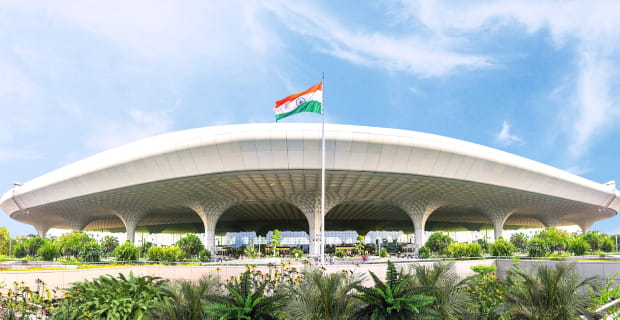
The civil aviation ministry has asked Adani Airports to defer a proposal that would have removed 265 of Mumbai airport’s 770 weekly international departures from October 25, the start of the winter schedule. The plan affected 46 airlines and was intended to free space at Terminal 2 for domestic services displaced by the redevelopment of Terminal 1. Further airline-operator meetings are scheduled for October 13 and October 20.
The headline is that flights have been saved, for now. The more serious story is that rebuilding one part of India’s financial-capital airport was capable of forcing a one-third cut in international departures at another terminal.
That is a resilience problem. Terminal 1 is due to begin redevelopment in January 2027, following concerns over ageing infrastructure. The north section of Terminal 1B will be demolished in the first phase, and the rebuild is designed to lift the terminal’s capacity from 15 million passengers a year to 20 million.
The work is needed. But closing or constraining Terminal 1 pushes domestic traffic into Terminal 2, which already handles Mumbai’s international network. The proposed answer was not to create a new runway, taxiway or apron overnight. It was to make room by cutting international departures.
That reveals what Mumbai lacks. A resilient airport has room to absorb maintenance, weather disruption, aircraft diversions, a terminal closure or an unexpected spike in demand. Mumbai has a tightly constrained airfield, limited aircraft stands, highly contested slots, dense terminal activity and road access that is already under strain. One terminal project therefore becomes an airport-wide capacity calculation.
The airport operator’s proposed 265-flight reduction was a terminal-management solution to a system problem. It would have cut about a third of international departures at Terminal 2, freeing gates, stands, baggage capacity, check-in space, security lanes, immigration processing and apron resources for domestic airlines moving from Terminal 1.
The missing public document is the capacity model behind that number. Mumbai International Airport Ltd should be able to show the pre and pos redevelopment analysis: peak like hour runway movements, contact-gate and remote-stand availability, domestic and international passenger processing limits, baggage-system capacity, immigration-counter demand, taxiway congestion and aircraft parking requirements. Without it, airlines are being asked to accept a large commercial disruption without a transparent explanation of why 265 flights are necessary rather than 100, 200 or none.
International airlines have resisted because a Mumbai slot is not merely a take-off time. It may anchor a bank of onward connections, crew rotations, cargo bookings, corporate contracts and aircraft utilisation across an entire network. A carrier cannot easily move a daily Mumbai service to an inconvenient hour, or to a different airport, without losing demand that took years to build.
The practical alternatives are uncomfortable but worth testing.
Navi Mumbai is the obvious release valve. It is also not a simple substitute. Adani Airports has offered airlines the option to move operations to Navi Mumbai International Airport at their discretion. But a second airport does not inherit the first airport’s passenger catchment, road access, corporate habits or network connectivity on opening day.
Moving a flight from Mumbai to Navi Mumbai is not just a terminal relocation. It changes airport access time, passenger behaviour, crew transport, cargo collection, ground handling, hotel contracts and connections. A traveller from South Mumbai, Thane or the western suburbs may see the two airports very differently. The same is true for a corporate traveller, a shipper and an international transfer passenger.
Navi Mumbai will become a meaningful relief valve only when its access network, ground transport, airline schedules and passenger expectations make it part of a functioning metropolitan airport system. Until then, it is a second airport with its own market to build.
The deferred cuts buy time. They do not add a runway, a gate, an immigration counter or an aircraft stand. Mumbai’s airport problem is not that Terminal 1 needs rebuilding. It is that one of Asia’s most commercially important cities has reached the point where essential maintenance and redevelopment threaten the functioning of the entire aviation system.
A future without spare capacity is not a future without disruption. It is a future in which every necessary repair becomes an argument over who must stop flying.