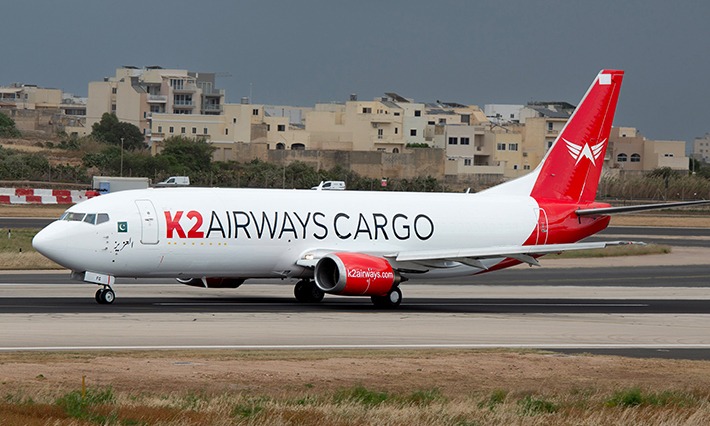
It was a routine Gulf evening when the K2 Airways Boeing 737 freighter pushed back from the stand at Sharjah International Airport, its cargo hold packed with commercial shipments bound for Karachi. Ground crews had already faded into the background. Inside the cockpit, five crew members two pilots, two engineers, and a support crewman ran through the familiar choreography of checklists, system scans, and clearances.
The route across the Arabian Sea was short and well‑trodden. Hundreds of flights had traced the same invisible corridor between Sharjah and Karachi, threading along airways where modern navigation systems, radar coverage, and procedural discipline turned dark water and night sky into a manageable path.
After departure, the 737 climbed steadily, levelling off into its cruise altitude as the lights of the UAE slipped behind and the black expanse of the Arabian Sea stretched out below. The cabin was quiet just the muted hum of avionics, the occasional crackle of radio calls, and the glow of instruments in shades of green and amber.
This was the easiest phase of the flight. Fuel checks, position reports, system monitoring tasks that were important but reassuringly familiar. Outside, there was almost nothing to see. No city lights, no terrain, only the faint halo of stars above and the invisible sea beneath. It was the kind of leg where experience and trust in the aircraft mattered more than any visual cue.
Somewhere about 155 nautical miles west of Karachi, that routine began to fray. They informed air traffic control, reporting a 'navigation system issue' and signalling that something on board was no longer behaving as expected. On the radar screens in Karachi’s control room, a single symbol representing the freighter continued along its path and then it was lost.
After that report, the aircraft’s behaviour changed abruptly. The track on radar showed a sharp heading change, breaking the smooth curve of the planned route. For controllers, this kind of deviation at night over water is instantly worrying. It suggests either a deliberate manoeuvre under stress or a loss of control that is beginning to express itself in the aircraft’s path.
Moments later, the freighter started to descend, first at a rate that might have seemed like a normal correction, then at a rate that made it clear something was deeply wrong. Instead of a controlled step‑down or emergency descent, the rate of loss in altitude skyrocketed. Data later indicated that in its final moments, the 737 was dropping through roughly 1,100 feet above sea level at a terrifying rate.
The story ended with a single, sickening event. Controller saw that the radar return vanished. One second there was a target, descending too quickly but still present, the next second, there was nothing. Radio calls went unanswered. Attempts to re‑establish contact yielded only silence and static.
At that moment, the K2 Airways cargo plane ceased being a flight and became an emergency. The aircraft had likely struck the Arabian Sea southwest of Karachi, somewhere off the coast near Ormara, in waters deep enough that wreckage and answers would not be easy to retrieve.
Within hours, teams at sea located wreckage consistent with the missing Boeing 737 freighter, confirming that the flight’s final minutes had ended in the water. The discovery brought a grim kind of closure to the question of whether the aircraft was still aloft but opened many more about why it fell from the sky in the first place.
Investigators will have flight data, radar traces, radio logs, maintenance records, company procedures, and whatever can be recovered from the wreckage. Was it because of the navigation fault or an avionics failure or human fatigue or spatial disorientation or a larger geopolitical tension? That will come out of deeper investigations.