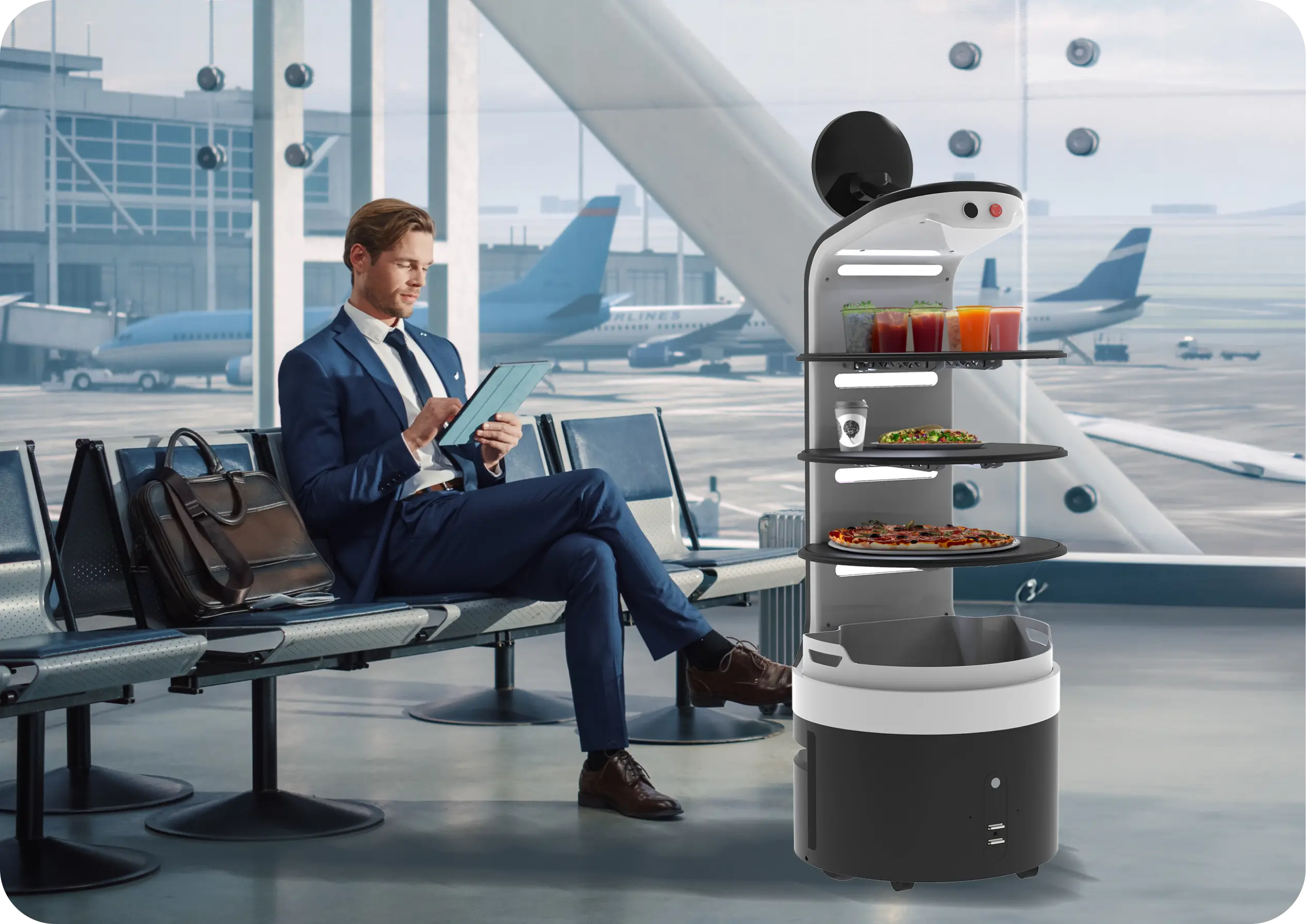
This week’s CATA aviation conference in Beijing was billed as artificial intelligence meeting civil aviation. China Eastern put an AI flexible-arm meal line on the stand and said the first production line went into its Pudong catering base in June, with summer daily output above 10,000 trays. The arm is described as grabbing mixed, non-standard items into airline boxes. A model is said to tag calories against a nutrition file. Hesai-style kitchen robots from Xixi Intelligent were already on a China Eastern 'healthy meal workstation' from 1 July, doing sort, place and leak checks that used to be a night shift of hands. At Pudong the same carrier has check-in and baggage robots on the floor and a transfer quadruped in trial. Those machines are what a passenger can film. They are not the part of the show that changes whether a delayed widebody still leaves.
The quieter exhibits were the ones that sit behind the fence. Hainan Airlines’ technical arm told the hall it now runs more than 1600 fault-prediction models and claims to have flagged more than 200 latent risks, shifting work from after-the-fact repair toward warning. Air China Group showed an unmanned, digitised wheel shop that has delivered a first batch. China Southern talked about a fuel cloud that links airline, airport, supplier and bank across more than 530 airports and said the 2025 saving was more than 230,000 tonnes. China Eastern added a maintenance large model it calls Ruiqing, a C919 operations dataset of more than 200,000 specialist Q&A pairs and an agent branded Yanbao. CAAC deputy administrator Han Jun used the same week to say the bureau’s 'AI plus civil aviation' guidance is meant to move pilots from demo to scale like stand allocation, crew rostering, dynamic recovery, predictive maintenance, fuel and cargo-station flow. He also said the industry cannot chase novelty. Safety standards are high and the chain is long.
A robotic plate line fails safely if a human puts the tray back. A rostering model that drops a legal rest, a health-monitoring system that misses a wheel crack or a disruption engine that re-times a bank without a human override fails in public. The tests that should follow every CATA booth are therefore dull and mandatory. Who owns the training data, and is it clean enough that a rare defect is not trained out? Where does the model sit relative to the approved maintenance data and the MEL? What is the cyber surface when an agent can touch fuel, bags and a passenger record? Who is licensed to reject the recommendation, and how is that rejection logged? Has the workforce been trained to treat the tool as a second opinion rather than a captain? Can the airline show a measurable cut in delay minutes, no-go defects or meal shortages that survives a winter irregularity, not only a summer display? Daxing opening 19 robot trial slots and China Mobile selling 5G skin-inspection kits are useful only if those questions have answers that a regulator can audit.
The visible robot is a passenger story. The invisible model is an operations story. China is putting both on the floor at once. The industry that will matter is the one that can prove the second without using the first as a substitute.