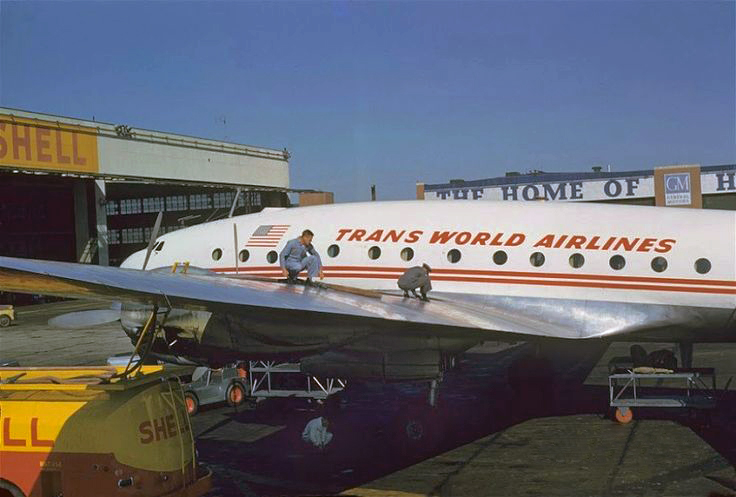
Before a TWA Super Constellation could leave, Bob Trumpolt had to finish examining its engines. The passengers were aboard, the pilots were ready, but the flight engineer still had work to do at a panel capable of revealing the electrical behaviour of the engines’ ignition systems. Some captains grew impatient while he completed the run-up.
On the L-1049G, known as the Super G, the engine analyser was an important part of that check. Flight engineers carried cue cards to help interpret the patterns it displayed. Trumpolt remembered identifying a 'double shorted secondary', a finding serious enough to indicate a damaged cylinder and an engine shutdown. The departure depended on what the instruments told him, not simply whether all four propellers were turning.
Trumpolt joined TWA’s final Constellation flight-engineer class in October 1964. He was 30 and had spent years instructing, flying charters and working as an air traffic controller. After four and a half months of training, he began operating the L-749, L-749A and L-1049G. He would accumulate more than 1,100 hours on the three types and later train other engineers.
His day began well before engine start. He carried a suitcase, a heavy bag of manuals and a tool kit up a narrow ladder into the aircraft. Then came the inspection, checking fluid quantities on the wings, examining the underside and landing-gear bays and looking for leaks in fuel, oil and hydraulic systems. Back in the cockpit, he read the technical log and maintenance sign-offs before briefing the captain.
The Constellation gave passengers a pressurised cabin and a distinctive view past four large propellers. Behind that comfort was a machine demanding close attention to engines, fuel, oil, electrics and cabin systems. Trumpolt’s station gathered those responsibilities around one specialist.
He recalled the engines being started in the order three, four, two, one. The copilot counted the propeller blades passing before calling for ignition. Smoke and sometimes flame, accompanied the Wright engines as their cylinders began firing. On the L-1049G, a porthole in the crew door gave the engineer a limited view of the two engines on the right, much of his knowledge came from the panel rather than a direct look outside.
Once running, the engines needed more than a check of speed. Oil pressure and temperature showed whether lubrication was behaving as expected. Cylinder-head temperature provided a warning of heat building in the engine. An air-cooled radial depended on airflow as well as its operating settings to keep temperatures within limits. Excessive heat could require changes to power, mixture or cooling airflow.
The controls also separated two things a passenger might assume were the same, engine power and propeller speed.
With a constant-speed propeller, the throttle changes the engine’s power input, while the propeller governor adjusts blade angle to maintain the selected rotational speed. Manifold pressure, the pressure in the engine’s intake system, helps indicate the engine’s operating condition. The crew must use approved combinations of manifold pressure and rpm rather than treating either gauge as a complete account of power.
The distinction is rather like selecting an engine’s workload separately from how fast it turns. The propeller’s blade angle changes how much air it works against, the governor keeps the selected rpm while the engine supplies the power.
On departure, those settings became sound and movement throughout the aircraft. Trumpolt remembered night takeoffs with the engines at power, a mighty roar and yellow exhaust flames streaming behind the stacks. As power was reduced for climb, the flames drew back. In cruise, the noise subsided and the propellers were adjusted to a smoother hum.
The work continued after the aircraft levelled off. A climb to avoid icing or turbulence could require a change in supercharger setting. In Trumpolt’s account, the captain first warned passengers that the sound would change and they might feel a thump. The engineer then reduced power on two engines, shifted their superchargers, restored power and repeated the process on the other pair. It was a coordinated operation, not a switch casually moved while the aeroplane carried on unchanged.
Trumpolt remembered doing it with a student engineer on his first line trip. The crew needed two such changes while trying to climb out of icing. Most newly qualified engineers, he wrote, did not encounter the procedure in service until later.
The return towards the runway brought another change in the cabin’s soundtrack. With landing gear and flaps extended, additional power produced the deep rumble of engines and propellers working against the aircraft’s increased drag. At night, Trumpolt watched the short blue exhaust flames lengthen into yellow as power rose.
He spent two and a half years on the Constellation before moving to the Boeing 707 in 1967, eventually retiring as a Lockheed L-1011 captain. The Connie remained special to him, an aircraft whose operation involved cold inspections, demanding study and a cockpit job he described as hard work that he loved.
To its passengers, the journey began with four engines running outside the windows. But to the flight engineer, it had begun much earlier with a ladder, a technical log and the first inspection of the day.